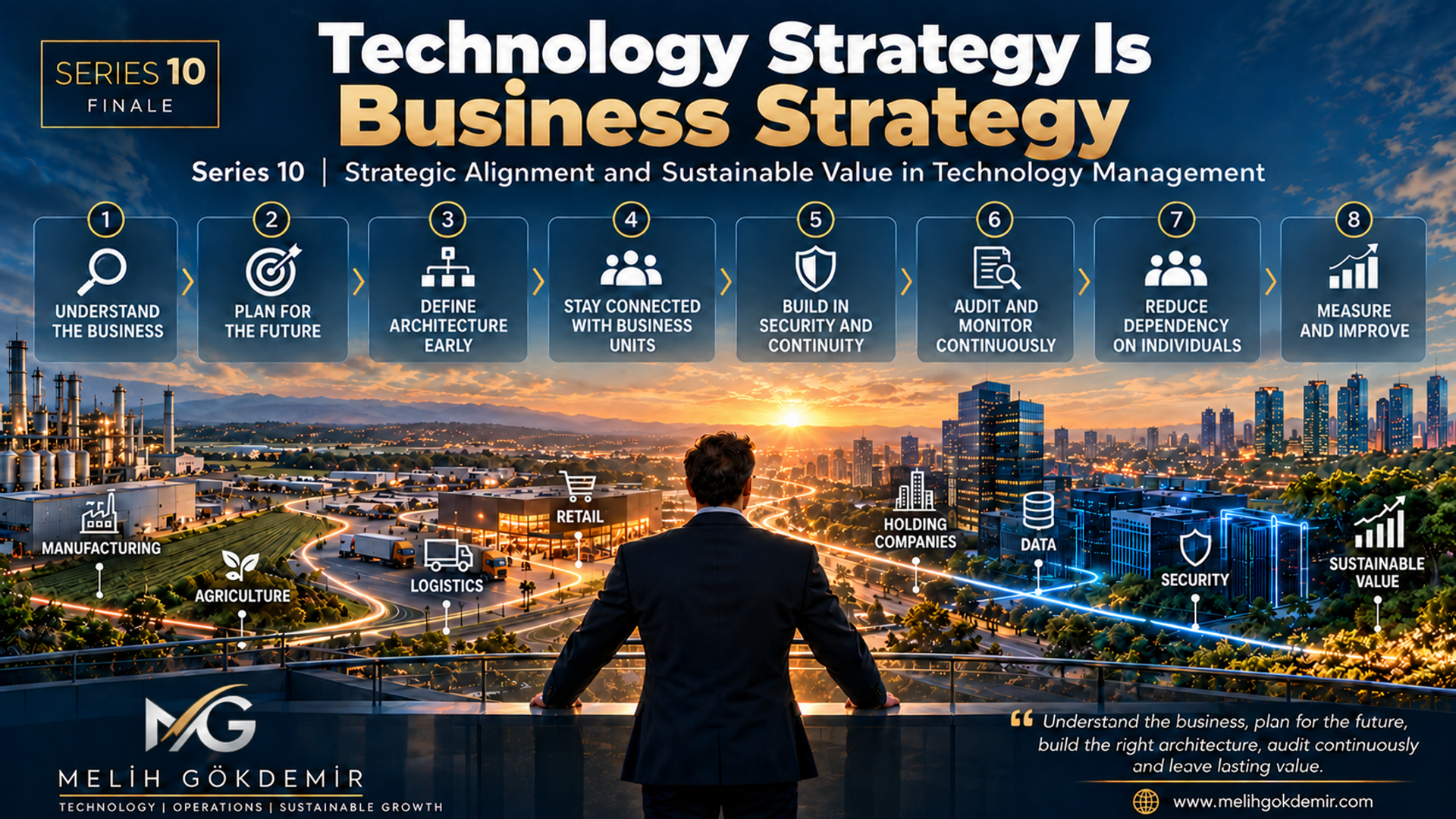
How should a company's technology strategy be defined?
Renewing existing systems, introducing new software, strengthening infrastructure and investing in security are all important responsibilities of technology management.
Yet what ultimately guides these decisions is the company's industry, its operational needs and its ambitions for the future.
If a manufacturing facility is planning to increase capacity, its technology architecture must be able to support that growth. When new stores open across retail operations, central systems need to adapt to the expanding organization. When new companies join a holding group, maintaining common standards, security policies and management processes becomes increasingly important.
For this reason, technology strategy should be shaped alongside the company's business objectives and operational realities.
With this article, we reach the end of my ten-part series on technology management.
Throughout the series, I have drawn on my experience across different industries to explore technology investments, system architecture, operational continuity, corporate governance and the creation of sustainable value.
In this final installment, I would like to bring together the ideas shared in the previous nine articles and summarize the fundamental approach I follow in technology management.
A Common Approach Shaped by Experience
Over the years, I have encountered different technology needs in manufacturing facilities, retail operations, logistics processes and holding companies.
Each organization differed in its business activities, size, ways of working and priorities. These differences directly influenced many decisions, from planning technology investments to managing systems in day-to-day operations.
In this series, I have explored topics ranging from technology planning during a factory's project stage to traceability, investment decisions, holding-company management, sustainable architecture, measurable value and organizational ownership.
At the heart of these experiences lies the following management approach:
- First, understand the industry and how the business works. Assess the industry's dynamics, operational processes, current needs and challenges accurately. Use this understanding as the foundation for technology decisions.
- Design a system architecture for the future. Consider the company's current needs alongside its growth ambitions, new operations and business processes that may change. Plan a secure, scalable and sustainable technology architecture.
- Define the architecture at the very start of the project. Evaluate requirements with the relevant business units, establish how processes relate to one another and clarify how systems will integrate during the planning stage. Consider the impact of later changes on operations and investment costs.
- Stay in continuous communication with the relevant departments. Evaluate processes together with manufacturing, finance, logistics, retail and other business units. Monitor operational changes, make decisions in line with shared objectives and ensure that responsibilities are owned across the organization.
- Build security and business continuity into the architecture from the outset. Plan all requirements as an integrated whole, from identity and access management and data security to backup, disaster recovery scenarios and operational continuity.
- Keep audit and control mechanisms operating continuously. Regularly audit system security, access rights, processes and performance. Identify risks promptly, take the necessary measures and monitor compliance with organizational standards.
- Move away from systems that depend on individuals. Do not shape technology architecture, business processes or management standards around particular individuals' knowledge and preferences. Establish organizational structures that allow systems to operate with the same discipline as roles and teams change.
- Measure results and keep improving. Evaluate how technology investments contribute to operational efficiency, decision-making, business continuity and the company's objectives. Improve systems as needs evolve.
Leaving Lasting Value for Organizations
Decisions made in technology management affect both an organization's current operations and the way it will work in the future.
It is therefore essential that the systems established are secure, manageable and sustainable.
Operating audit mechanisms, preserving organizational standards and running processes independently of individuals support the continuity of the technology environment that has been created.
Managers, employees and teams may change over time. Yet the organization's accumulated knowledge, working discipline and the value built over the years should be preserved and continue to develop.
We all contribute to the future of the organizations we work for. Protecting organizational resources, sharing responsibility and creating sustainable value through our decisions are therefore responsibilities we all share.
Across these ten articles, I have tried to share the experience I have gained over the years in different industries and organizations.
My aim was not simply to describe the technical aspects of technology projects, but to demonstrate the importance of sound planning, organizational responsibility, continuous auditing and a sustainable management approach for the future of companies.
I hope these reflections have offered a different perspective to those interested in technology management and those working to create lasting value within their organizations.
This brings my ten-part technology management series to a close.
I would like to summarize the most important lesson I have drawn from this journey in these words:
First understand the business, plan for the future, build the right architecture, audit continuously and leave lasting value for the organization.
Because technology strategy is an integral part of the business strategy that shapes a company's future.
This article is original content by Melih Gökdemir. Short quotations may be used with attribution. Reproduction, republication or commercial use of the full article or a substantial part of it without permission is prohibited.